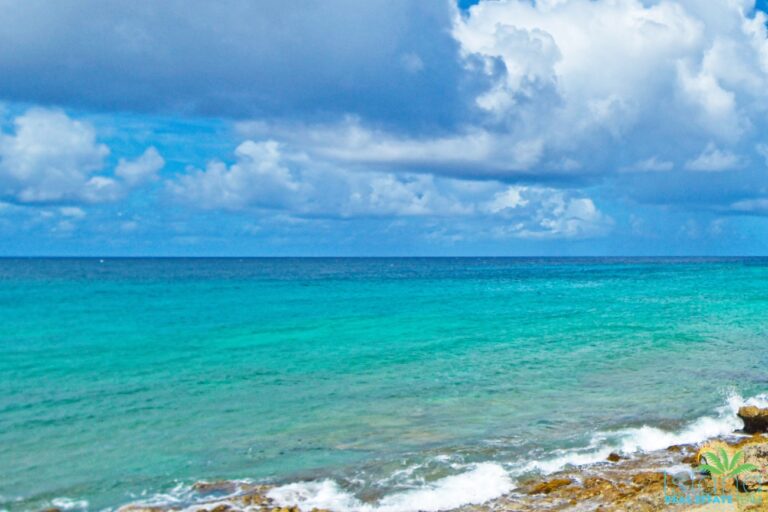

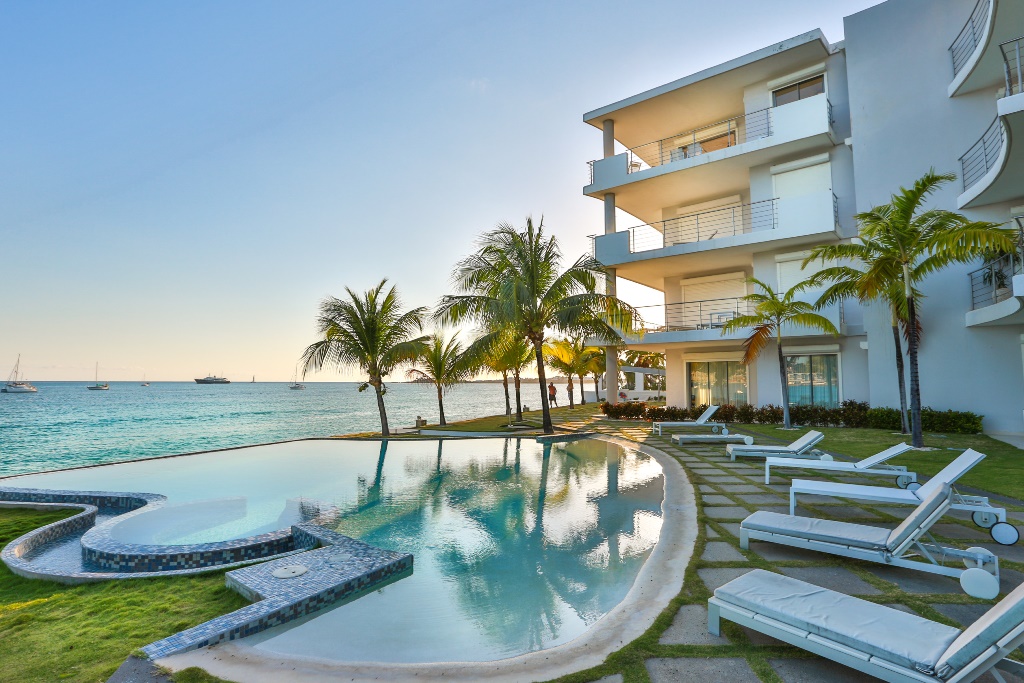
If you are buying on the numbers, the Dutch side usually wins. Entry cost is about 5 to 6 percent against roughly 8 to 10 percent, there is no annual property tax, and there is no capital gains tax when you sell. If you are buying on how you want to spend your Saturdays, the French side often wins. Baie Rouge, Plum Bay and Long Bay are the best stretches of sand on the island, and Grand Case is its culinary capital.
Almost every buyer arrives with this question and leaves having chosen a neighbourhood rather than a side. That is the right way round. Thirty seven square miles, one open border, no passport control between the two: you can live at Pelican Key and eat at the lolos in Grand Case on a Tuesday night without thinking about it.
Here is the full comparison, honestly weighted. Rules change on both sides, so confirm your own position with a notary or notaire and a tax adviser before you sign.
One island, two countries, no border post
The island has been shared since the Treaty of Concordia in 1648 and is the smallest landmass in the world divided between two nations. Sint Maarten became an autonomous country within the Kingdom of the Netherlands on 10 October 2010, a date everyone here calls ten ten ten. Saint Martin became a French overseas collectivity in 2007. In daily life the border is a sign on the road at Cole Bay or on the climb to Oyster Pond. You drive across it. What changes is the legal system, the tax regime, the currency and the language of officialdom, and those four things are the whole decision.
The comparison at a glance
| Dutch side, Sint Maarten | French side, Saint Martin | |
|---|---|---|
| Status | Autonomous country in the Kingdom of the Netherlands | French overseas collectivity |
| Currency | Guilder official, pegged near 1.79, property trades in US dollars | Euro |
| Working language | English in business, Dutch official | French |
| Transfer tax or duties | 4 percent | Combined with notaire fees |
| Notary or notaire | Roughly 1 to 2 percent | Fees and duties together, 7 to 10 percent |
| Total entry cost | 5 to 6 percent, or 6 to 7 percent with a local mortgage | 8 to 10 percent |
| Annual property tax | None | Taxe fonciere applies |
| Capital gains on resale | None | Up to 34 percent, relief for a main home |
| Land registry | Kadaster | French system, run through the notaire |
| Foreign ownership | Freehold, no nationality restriction | Freehold, no nationality restriction |
| Utilities and hospital | GEBE and TelEm, SMMC in Cay Hill | French providers, Louis Constant Fleming in Concordia |
| Character | Marinas, commerce, nightlife, the airport | Beaches, food, village life, larger parcels |
The Dutch versus French comparison tool in our property tools suite lets you drop a real purchase price into that table and see both sets of costs.
The money
Getting in
Take a 900,000 purchase as an illustration. Dutch side closing costs at 5 to 6 percent are roughly 45,000 to 54,000. French side costs at 8 to 10 percent are roughly 72,000 to 90,000. That is a gap of about 27,000 to 36,000 on day one, before furniture. Those are illustrative figures from the ranges above, not quotations.
Holding
Sint Maarten has no annual property tax. Your recurring costs are association dues, insurance including windstorm cover, GEBE power and water, and maintenance. Saint Martin has all of that plus taxe fonciere every year, and on a long hold the difference compounds quietly.
Getting out
This is the line buyers overlook. There is no capital gains tax on a Dutch side resale. On the French side a gain can be taxed at up to 34 percent, with relief where the property was the seller’s main home. If that same 900,000 property sold years later at 1,100,000, the 200,000 gain is untaxed locally on the Dutch side, while on the French side a taxable gain of that size could attract a significant charge. Your home country may tax you either way, which is a separate conversation with your accountant.
Law, currency and admin
Both sides run a notarial system, and in neither case is the notary your advocate. On the Dutch side the notary is a neutral officer of the law acting for the transaction: verifying title, searching the Kadaster for mortgages and liens, confirming that taxes and GEBE accounts are settled, drafting the deed, holding the funds and registering the transfer. It is efficient and it is conducted in English.
The French side runs on French law, which buyers often describe as strong on consumer protection. Expect more prescribed procedure, more calendar time, and a file that moves in French. Neither system is riskier. They are differently paced.
Dutch side property is quoted and settled in US dollars even though the guilder is official, which removes exchange risk for a buyer earning in dollars. Local lending is available through banks including Windward Islands Bank, RBC, Republic Bank and Orco Bank. French side property is in euro, so if your money is in dollars the exchange rate becomes part of your return whether you want it to be or not.
Lifestyle, honestly
The Dutch side
This is where the island does business. Princess Juliana International Airport sits at Maho, so from Cupecoy, Maho or Simpson Bay you are minutes from departures. That single fact drives enormous demand from owners who fly in and out often. Simpson Bay Marina, Palapa Marina, Isle de Sol and Yacht Club Port de Plaisance make it the yachting centre of the northeastern Caribbean, and the Heineken Regatta in early March fills every bed on the island.
You also get the restaurants of Simpson Bay, Front Street and the Boardwalk in Philipsburg with cruise ships at Port St. Maarten, the island’s only golf course at Mullet Bay, Porto Cupecoy for a quieter marina square, and the hospital at Cay Hill. It is convenient and it is busy. When the Simpson Bay bridge opens for yachts the queue is real, which is why residents learn to use the Causeway.
The French side
Slower and prettier. Terres Basses is the island’s luxury villa market, with large parcels and access to Baie Rouge, Plum Bay and Long Bay. Grand Case is one boulevard running from fine dining down to the lolos, the open air barbecue stands, and Harmony Nights closes the street on Tuesdays in season. Orient Bay is the best known beach on the island and carries real holiday rental demand. Marigot has the harbour, the market and Fort Louis above it, and Pic Paradis rises behind everything to about 424 metres, with hiking and ziplines at Loterie Farm.
The tradeoffs are practical. Administration is in French, entry and holding costs are higher, and you are further from the airport than a Cupecoy owner. For a buyer whose priority is beach, food and space, none of that outweighs Baie aux Prunes at seven in the morning.
Rental demand
Both sides rent well. They rent to different people.
- Dutch side: the broadest demand pool. Simpson Bay and Maho pull holiday guests, business travellers, yacht crew and airport driven stays. Cupecoy and Pelican Key do well with repeat guests who want sea views and easy access.
- French side: demand concentrates on villas and beach proximity. Terres Basses and Orient Bay perform strongly in high season, roughly mid December to mid April, though the season is more concentrated.
- Both: the quiet stretch is late August to October, inside a hurricane season that runs 1 June to 30 November. Underwrite on the full year, never on a February week.
Run anything you are considering through the rental yield calculator in the property tools using realistic occupancy.
Who each side genuinely suits
Buy Dutch if
- You want the lowest entry cost, no annual property tax and no capital gains tax on exit.
- You are buying as an investment and want the widest rental pool.
- You fly often and want to be minutes from SXM.
- You want the transaction and your ongoing admin in English, or you keep a boat.
Buy French if
- Beaches are the point. Baie Rouge, Long Bay and Orient Bay are not matched on the Dutch side.
- You want a villa on a large private parcel, particularly in Terres Basses.
- You value French law and French food, and you are comfortable operating in French.
- You are buying a main home rather than an asset, which also changes how gains relief may apply.
The answer most buyers land on
Buy Dutch, eat French. The cost structure on the Dutch side is hard to argue with, and Grand Case is a short drive with no border formality. Oyster Pond, sitting on the boundary with its marina and sheltered water, is the literal version of that compromise, and buyers there should always confirm which side of the line a specific property falls on, because it decides everything in the table above.
The exception is the buyer who has fallen for one villa in Terres Basses or one view above Grand Case. Then the numbers are not the decision. Just go in knowing them.
Häufig gestellte Fragen
Is it cheaper to buy on the Dutch side or the French side?
The Dutch side is cheaper to enter, at roughly 5 to 6 percent against 8 to 10 percent, cheaper to hold because there is no annual property tax, and cheaper to exit because there is no capital gains tax.
Can foreigners buy on both sides?
Yes. There is no restriction on foreign ownership on either side, and both offer freehold title.
Do I need a passport to cross between the sides?
There is no border post between them in daily life. You drive across. Arriving on the island by air or sea is a separate matter with normal immigration procedures.
Which side has better rental income?
The Dutch side generally has broader, steadier demand thanks to the airport, the marinas and the resort districts. The French side can achieve very strong villa rates in high season. Compare full year occupancy, not peak rates.
Which side is better for a permanent home?
It depends what you want your week to look like. The Dutch side is more convenient and more commercial. The French side is quieter, with better beaches and better food. On an island this size you are never far from either.
Work out your own answer
Put a real price into the Dutch versus French comparison in our property tools, then look at what is actually for sale on each side in the current listings. The gap becomes much clearer when you are comparing two specific properties instead of two jurisdictions. When you want to narrow it down, get in touch. We work both sides of the island every week and we will tell you plainly which one fits what you are trying to do.